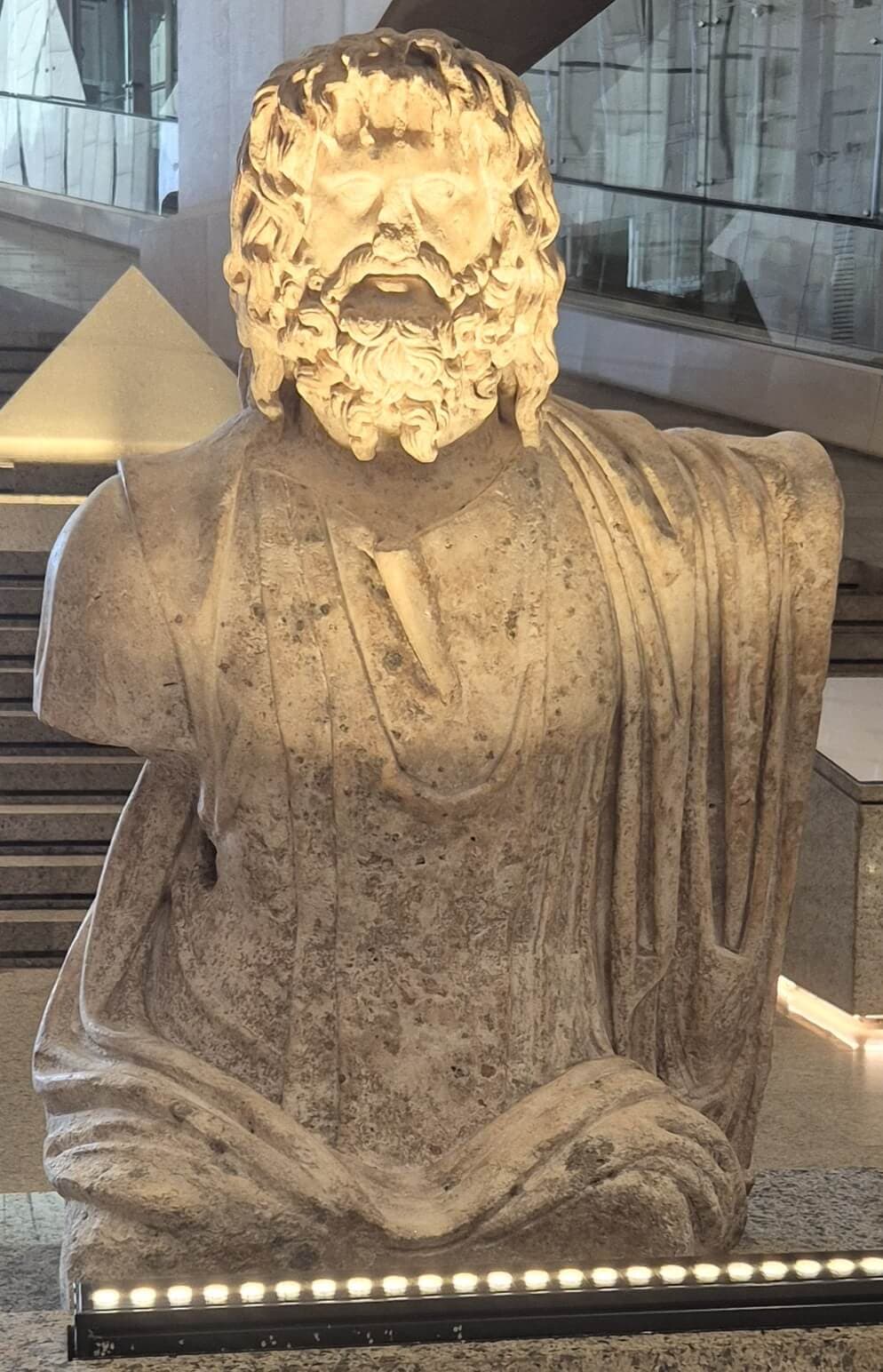
The statue before you represents Serapis, a syncretic deity introduced during the early Ptolemaic period to unify Greek and Egyptian religious traditions. Serapis embodied a blend of Egyptian and Hellenistic elements—he was associated with Osiris and Apis in Egyptian tradition, and with Zeus, Hades, and Asclepius in the Greek worldview. He represented the afterlife, fertility, healing, and abundance.
Alexandria, the Ptolemaic capital, became the center of Serapis worship. His cult was politically crafted by Ptolemy I to bridge cultural divides between Greek settlers and native Egyptians. From Alexandria, devotion to Serapis spread widely throughout Egypt and the Mediterranean world.
In art, Serapis was portrayed in a Greek style—with a full beard, long hair, and often wearing a modius (grain basket) on his head, symbolizing fertility and abundance. His imagery reflected the merging of Greek aesthetics with Egyptian religious symbolism, reinforcing the image of divine unity and political harmony.
This statue was originally located in the grand Serapeum of Alexandria, a vast temple that symbolized religious synthesis and royal power. Unfortunately, with the rise of Christianity in the late 4th century CE, Serapis’ worship was suppressed. In 389 CE, Emperor Theodosius I ordered the destruction of pagan temples, including the great Serapeum.
Despite its downfall, Serapis remains a powerful symbol of cultural fusion—a divine figure born from two civilizations, embodying the complexity of identity in ancient Egypt under Greek rule.The statue before you represents Serapis, a syncretic deity introduced during the early Ptolemaic period to unify Greek and Egyptian religious traditions. Serapis embodied a blend of Egyptian and Hellenistic elements—he was associated with Osiris and Apis in Egyptian tradition, and with Zeus, Hades, and Asclepius in the Greek worldview. He represented the afterlife, fertility, healing, and abundance.
Alexandria, the Ptolemaic capital, became the center of Serapis worship. His cult was politically crafted by Ptolemy I to bridge cultural divides between Greek settlers and native Egyptians. From Alexandria, devotion ... Entdecken Sie mehr mit Premium!
Entsperren Sie die vollständige Geschichte dieses ArtefaktsWerden Sie Premium-Mitglied, um auf die vollständige Beschreibung, Audioguides und exklusive Inhalte aller Artefakte zuzugreifen.Erhalten Sie vollen Zugriff auf Audioguides, detaillierte Beschreibungen und Sprachassistenten für Touren der wichtigsten Artefakte des GEM für nur 3.99 $