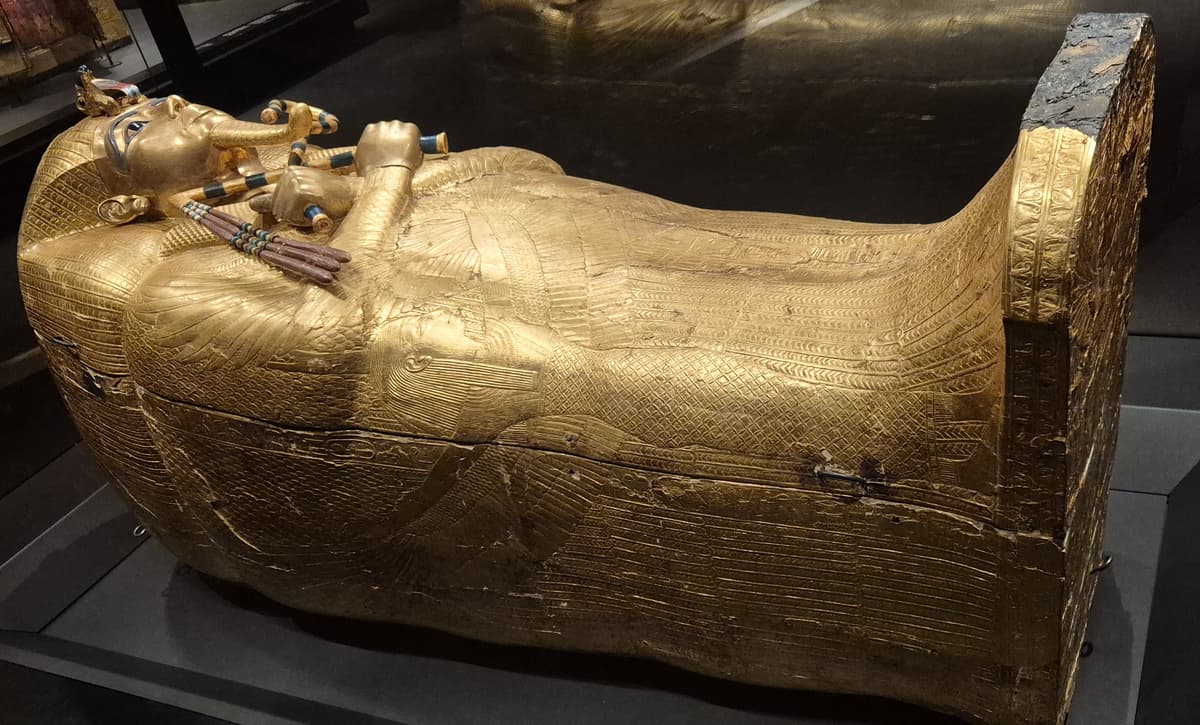
The Gilded Outer Coffin is the largest of the three anthropoid coffins that protected the mummy of Tutankhamun, the young king of Egypt who ruled during the 18th Dynasty of the New Kingdom around 1332 to 1323 BCE. This coffin formed part of an elaborate series of protective layers placed around the king’s body inside his stone sarcophagus. It was discovered in 1922 by the archaeologist Howard Carter in the royal tomb located in the Valley of the Kings.
Ancient Egyptian royal burials often included several nested coffins designed to protect the body and assist the king’s spiritual transformation in the afterlife. Tutankhamun’s burial contained three such coffins placed one inside the other. The outer coffin displayed here enclosed the two inner coffins, including the famous solid gold coffin that directly contained the king’s mummy.
The surface of the coffin is richly decorated with gold leaf and intricate religious imagery. One of the most distinctive decorative elements is the rishi style, a feather pattern that covers much of the coffin’s surface. This feather design symbolized divine protection and rebirth. In ancient Egyptian belief feathers represented the wings of protective deities that surrounded and guarded the deceased.
The coffin is also decorated with the outstretched wings of the goddesses Isis and Nephthys. These two powerful sisters were central figures in Egyptian funerary mythology. According to ancient religious texts they protected and revived the god Osiris after his death. Because of this myth they were believed to protect deceased kings and help ensure their rebirth in the afterlife.
The coffin is shaped in the form of the king himself, wearing royal regalia and holding sacred symbols associated with kingship. This anthropoid design reflected the belief that the deceased ruler would be transformed into an eternal divine being.
Ancient Egyptians believed that after death the king became identified with Osiris, the ruler of the underworld. Spells and protective inscriptions placed both inside and outside the coffin were intended to assist this transformation and protect the king on his journey through the afterlife.
Constructed from wood and covered with layers of gold, glass, faience, and other precious materials, the coffin demonstrates the extraordinary craftsmanship achieved by artisans of the New Kingdom. Every detail reflects the deep religious beliefs surrounding death, protection, and eternal life.
Today the Gilded Outer Coffin remains one of the most powerful symbols of the elaborate burial traditions that ensured the eternal survival of Egypt’s pharaohs.The Gilded Outer Coffin is the largest of the three anthropoid coffins that protected the mummy of Tutankhamun, the young king of Egypt who ruled during the 18th Dynasty of the New Kingdom around 1332 to 1323 BCE. This coffin formed part of an elaborate series of protective layers placed around the king’s body inside his stone sarcophagus. It was discovered in 1922 by the archaeologist Howard Carter in the royal tomb located in the Valley of the Kings.
Ancient Egyptian royal burials often included several nested coffins designed to protect the body and assist the king’s spiritual transformation in the afterlife. Tutankhamun’s burial contained three such coffins placed one inside the other. The outer coffin displayed here enclosed the two inner coffins, including the famous solid gold coffin that directly contained the king’s mummy.
The surface of the coffin is richly decorated with gold leaf and intricate religious imagery. One of the most distinctive decorative elements is the rishi style, a feather pattern that covers much of the coff ... Entdecken Sie mehr mit Premium!
Entsperren Sie die vollständige Geschichte dieses ArtefaktsWerden Sie Premium-Mitglied, um auf die vollständige Beschreibung, Audioguides und exklusive Inhalte aller Artefakte zuzugreifen.Erhalten Sie vollen Zugriff auf Audioguides, detaillierte Beschreibungen und Sprachassistenten für Touren der wichtigsten Artefakte des GEM für nur 3.99 $