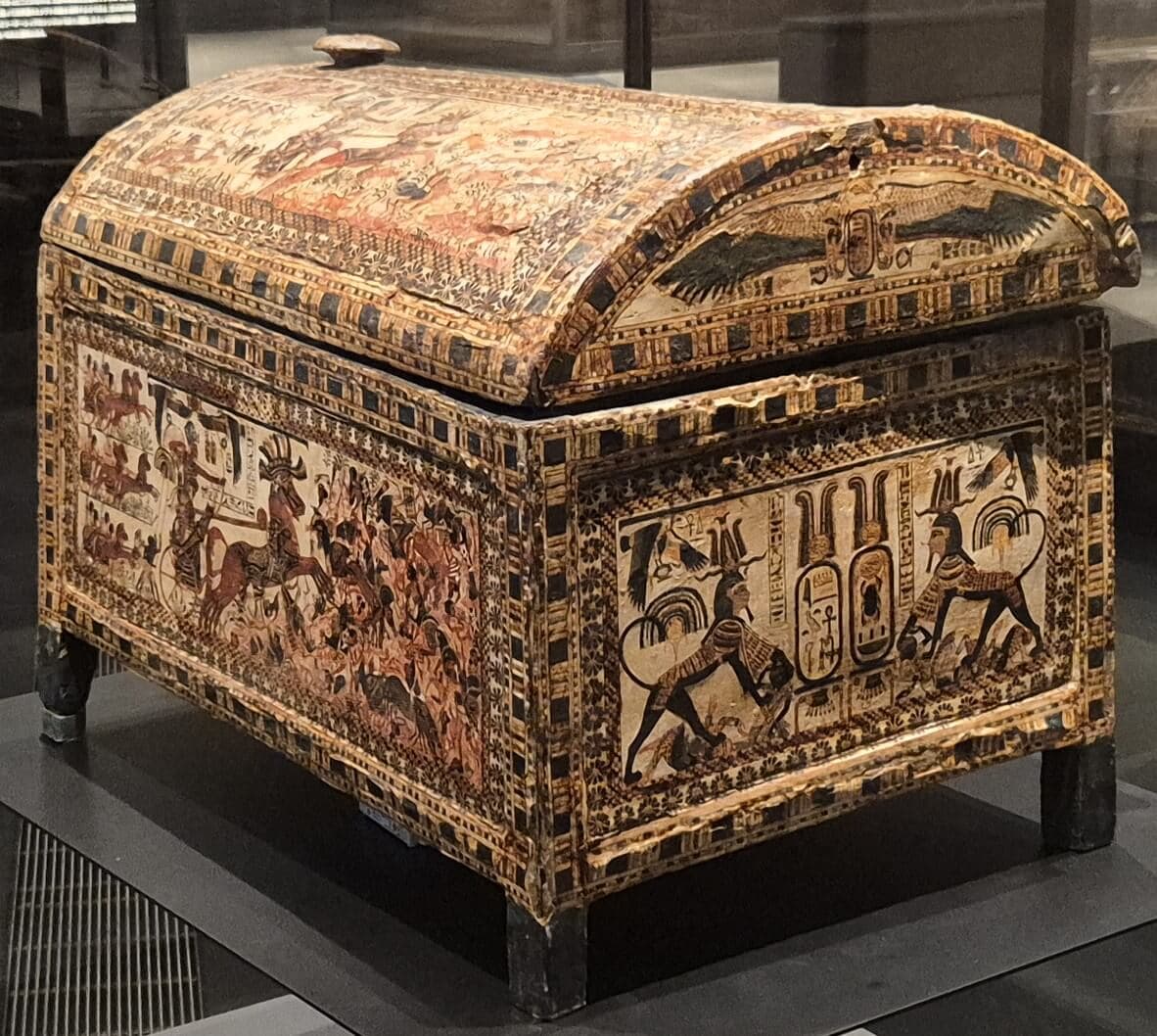
The Hunting Box of Tutankhamun is one of the most beautifully decorated objects discovered in the king’s tomb in the Valley of the Kings in 1922 by the archaeologist Howard Carter. Found in the antechamber of the tomb, this wooden box is covered with gesso and painted with extremely detailed miniature scenes that show the young king engaged in royal hunting and military triumphs.
The box is remarkable for its artistic quality. Early Egyptologist James Henry Breasted described it as the work of a master artist because of the exceptional skill displayed in the miniature paintings. The scenes are not only decorative but also symbolic. They portray Tutankhamun hunting wild animals in the desert and defeating foreign enemies. In ancient Egyptian royal ideology these images represented the king’s role as the protector of order and stability in the world.
One side of the box shows the king hunting dangerous animals such as lions and antelope in the desert. Hunting scenes were common in royal art because they symbolized the king’s courage and ability to control the forces of chaos represented by wild nature. The king is shown riding in a chariot and drawing his bow with great confidence. These images reflect the importance of chariot warfare and elite hunting during the New Kingdom period.
Another side depicts Tutankhamun confronting foreign enemies such as Nubians and Levantine peoples. These scenes symbolize Egypt’s political power and the pharaoh’s duty to defend the country from external threats. The enemies are shown falling beneath the king’s power, a common motif in ancient Egyptian art that represents the triumph of order over chaos.
At the ends of the box the king is depicted as a sphinx trampling his enemies. The sphinx was a powerful royal symbol that combined the body of a lion with the head of a king. It represented strength, divine authority, and the protective power of the pharaoh. By portraying the king as a sphinx, the artist emphasized that Tutankhamun was not only a human ruler but also a divine protector of Egypt.
Although this box was likely used to store personal items such as clothing or hunting equipment, its decoration shows that even practical objects in royal life were transformed into works of art. The vivid colors and fine details demonstrate the extraordinary craftsmanship of artists working for the royal court during the Eighteenth Dynasty.
Today the Hunting Box provides historians with valuable insight into royal ideology, artistic techniques, and the symbolism of kingship in ancient Egypt. It also reminds visitors that Tutankhamun, who became king at a very young age, was portrayed as a powerful and victorious ruler whose duty was to maintain balance and harmony in the universe.The Hunting Box of Tutankhamun is one of the most beautifully decorated objects discovered in the king’s tomb in the Valley of the Kings in 1922 by the archaeologist Howard Carter. Found in the antechamber of the tomb, this wooden box is covered with gesso and painted with extremely detailed miniature scenes that show the young king engaged in royal hunting and military triumphs.
The box is remarkable for its artistic quality. Early Egyptologist James Henry Breasted described it as the work of a master artist because of the exceptional skill displayed in the miniature paintings. The scenes are not only decorative but also symbolic. They portray Tutankhamun hunting wild animals in the desert and defeating foreign enemies. In ancient Egyptian royal ideology these images represented the king’s role as the protector of order and stability in the world.
One side of the box shows the king hunting dangerous animals such as lions and antelope in the desert. Hunting scenes were common in royal art because they symbolized the king’s courage and ability to control the forces of chaos represented ... Découvrez plus avec Premium !
Débloquez toute l'histoire de cet artéfactPassez à Premium pour accéder à la description complète, aux guides audio et au contenu exclusif de tous les artéfacts.Accédez aux guides audio complets, descriptions détaillées et assistant vocal pour les visites des principales œuvres du GEM pour seulement 3.99 $